
School-based occupational therapy in practice
Creating Calm, Predictable Classrooms
An occupational therapy approach to supporting regulation, independence and participation through practical changes to the classroom environment.
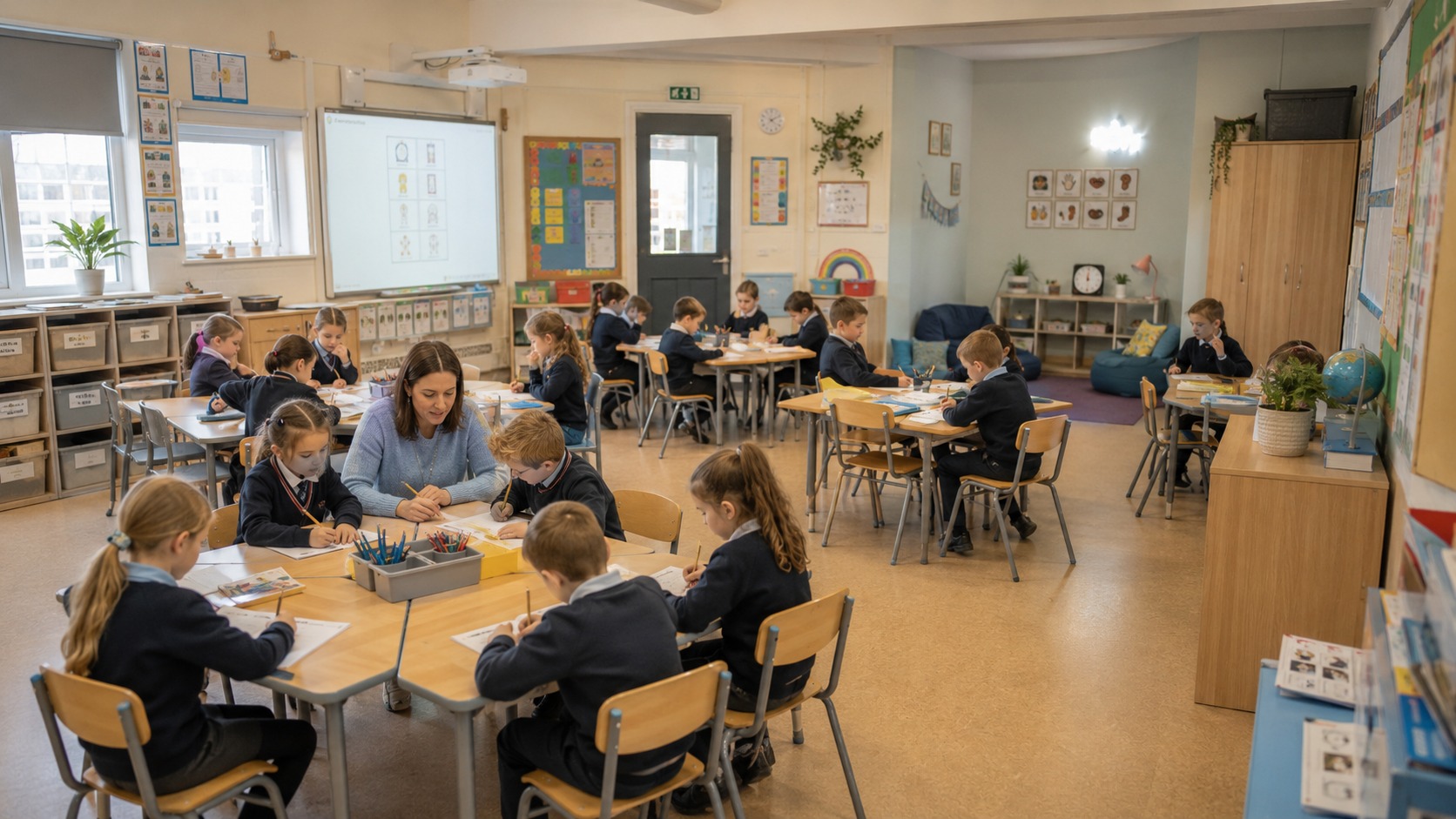
Looking beyond the individual child
When people think about occupational therapy in schools, they often picture support for one child. Some of the most useful changes begin by looking at the environment around the whole class.
Participation is shaped by the relationship between the person, the activity and the environment. Changes to classroom layout, routines, communication and sensory demands may improve access for many pupils at the same time.
This article shares a de-identified example of how environmental supports were explored to create a calmer and more predictable classroom.
Privacy note: This article draws on common themes from school-based occupational therapy practice. It is not a verbatim account of one classroom. Details have been combined, anonymised and adapted to protect pupils, staff and schools.
The starting point
Starting with the environment
A class teacher identified several pressures affecting learning and participation throughout the school day. Rather than beginning with individual pupils, the teacher and occupational therapist explored what the classroom itself was asking pupils to manage.
What the teacher was noticing
- Difficulties moving between activities and routines
- Increasing noise, particularly later in the day
- Frequent adult prompting for organisation
- Fatigue and reduced attention in the afternoon
- Limited opportunities to pause and regulate within the room
- Inconsistent use of visual and environmental supports
Occupational therapy lens
A collaborative classroom walkthrough
Using occupational therapy reasoning and guidance from the National Council for Special Education, the teacher and occupational therapist completed a classroom walkthrough. The aim was to notice strengths, barriers and realistic opportunities for change.
Visual environment
Wall displays, visual resting space, classroom zoning, organisation of materials and the amount of competing information.
Routines and transitions
Predictability, verbal prompting, packing and unpacking, movement between activities and how pupils knew what came next.
Sensory demands
Noise, lighting, movement opportunities, access to quieter space and the availability of regulation supports across the day.
A key strength was the teacher’s willingness to notice what already worked and to test small changes that fitted ordinary classroom life.
Universal classroom supports
Supporting predictability through visuals
Many pupils participate more independently when they know what is happening, what is expected and what comes next. Visual supports reduce the need to hold repeated verbal instructions in mind.
The supports were introduced for the whole class rather than designed for one named pupil.
Examples introduced
- A whole-class visual timetable
- Voice-level visuals
- Visual routines for packing and unpacking
- Transition prompts
- Short task-specific visual schedules
- Clearer organisation of frequently used materials
Regulation within the classroom
Creating a structured Calm Corner
The teacher identified a need for a place where pupils could take a brief pause without becoming disconnected from the class. A Calm Corner was created using existing classroom furniture and resources.
The planning began with purpose rather than equipment. The team considered who might use the space, when it might help, how pupils would access it and what would support a return to learning.
Clarify the purpose
Was the space intended to reduce stimulation, offer a short pause, support movement or help a pupil prepare to return to an activity?
Plan access and return
The routine included how a pupil would request the space, how long it might be used and how the pupil would rejoin classroom activity.
Use simple supports
Clear visual expectations, a visual timer, reduced visual demand and familiar regulation options were prioritised over large amounts of equipment.
Teach the routine
Pupils were shown how and when to use the area. They practised the routine during calm times, with modelling and consistent adult language.
An important distinction
A Calm Corner is not a punishment space
The area was not introduced as a consequence for behaviour, a reward space or a place to send pupils away from learning. It formed one part of a wider classroom approach to regulation, predictability and participation.
Participation and belonging
Listening to pupil voice
Pupils often notice features of the classroom that adults overlook. Their views helped the team understand which parts of the environment supported learning and which parts made participation harder.
Pupils were invited to consider
- What helps me learn?
- What makes learning more difficult?
- What would I change about the classroom?
- What would my ideal classroom include?
- Where do I feel most ready to learn?
Working together
Coaching, modelling and ongoing adjustment
Environmental change rarely happens after one visit. School-based occupational therapy often involves shared problem-solving over time.
Teacher expertise
The teacher understands the pupils, curriculum, classroom demands and what is realistic within the school day.
Occupational therapy perspective
The occupational therapist looks at participation, regulation, activity demands, routines and the fit between pupils and their environment.
Shared review
Strategies are observed, discussed and adjusted. Supports remain useful only when staff and pupils understand them and can use them consistently.
Teachers are experts in their classrooms. Occupational therapy adds a different lens, helping the team consider participation, regulation and environmental fit.
Reviewing what helps
The space was not treated as finished
A strategy that looks useful on paper might work differently in a busy classroom. The teacher and occupational therapist continued to review the routines and make practical adjustments.
Questions used during review
- Do pupils understand the visual supports?
- Are transitions becoming clearer?
- Is the Calm Corner being used for its intended purpose?
- Do pupils return to classroom activity more easily?
- Which supports are realistic for staff to maintain?
- What are pupils telling us about the changes?
Practical outcomes
Small changes with a whole-class purpose
The changes did not ask pupils to work harder at managing an inaccessible environment. They aimed to make the classroom easier to understand and use.
Clearer routines
Visual information and organised materials supported pupils to rely less on repeated adult instructions.
Smoother transitions
Predictable prompts helped pupils understand when an activity was ending and what was expected next.
More regulation options
Movement opportunities and a structured Calm Corner gave pupils practical ways to pause and prepare to re-engage.
Greater independence
Whole-class supports made everyday organisation and classroom routines easier to follow.
Stronger staff consistency
Shared visuals, language and routines gave adults a more consistent way to support pupils.
More pupil involvement
Pupil voice helped shape changes that felt relevant to the people using the classroom every day.
Flexible support
Universal supports do not replace individual understanding
Whole-class strategies improve access for many pupils, but they do not mean every pupil needs the same support. Some pupils require adapted communication, individual assessment, different regulation options or more focused planning.
The aim is not to make every pupil use the same strategy. It is to create enough flexibility for different pupils to participate in ways that make sense for them.
Further guidance
NCSE occupational therapy resources for schools
The National Council for Special Education provides free resources to help school staff consider classroom environments, sensory spaces and sensory demands.
NCSE booklet
Sensory Spaces in Schools
Guidance to help school staff consider the purpose, setup and effective use of sensory spaces.
Open the NCSE BookletNCSE booklet
The Physical Classroom Environment
Practical guidance on creating inclusive and adaptable classroom environments that reduce barriers to participation.
Open the Classroom GuideNCSE resource library
Occupational Therapy Resources for Teachers
Browse the NCSE collection, including classroom sensory and movement resources.
View All NCSE OT ResourcesQuestions schools often ask
Planning practical environmental support
Does a school need a separate sensory room?
No. A quieter classroom area, a structured Calm Corner, movement opportunities or changes to classroom routines might address the identified need more effectively. Planning should begin with purpose rather than room size or equipment.
Does a Calm Corner need specialist equipment?
Not always. Existing furniture, clear visual expectations, reduced clutter, a timer and familiar supports might be enough. Equipment should be selected only when it has a clear purpose and staff understand how it will be used.
Should every pupil use the space in the same way?
No. Pupils differ in how they regulate, communicate and return to activity. A universal classroom routine may provide a starting point, while some pupils need individualised planning.
When might occupational therapy consultation help?
Consultation may help when a school wants to review classroom demands, plan sensory or calm spaces, strengthen universal supports, improve transitions or build staff confidence around participation and regulation.
Final reflection
Children do not learn separately from their environment
Sometimes the next step is not asking a child to try harder or behave differently. It is asking what the environment communicates, what it demands and how it might better support participation.
Calm, predictable and inclusive classrooms give pupils clearer access to learning, relationships, regulation and belonging.
This resource provides general educational information. It does not replace individual occupational therapy assessment, school support planning or advice based on a pupil’s specific needs.
Explore practical occupational therapy support for your school
Belong OT works with education teams to consider classroom environments, routines, regulation supports and practical changes that fit everyday school life.