
Health Insurance and Occupational Therapy: Five Things Every Irish Family Should Check
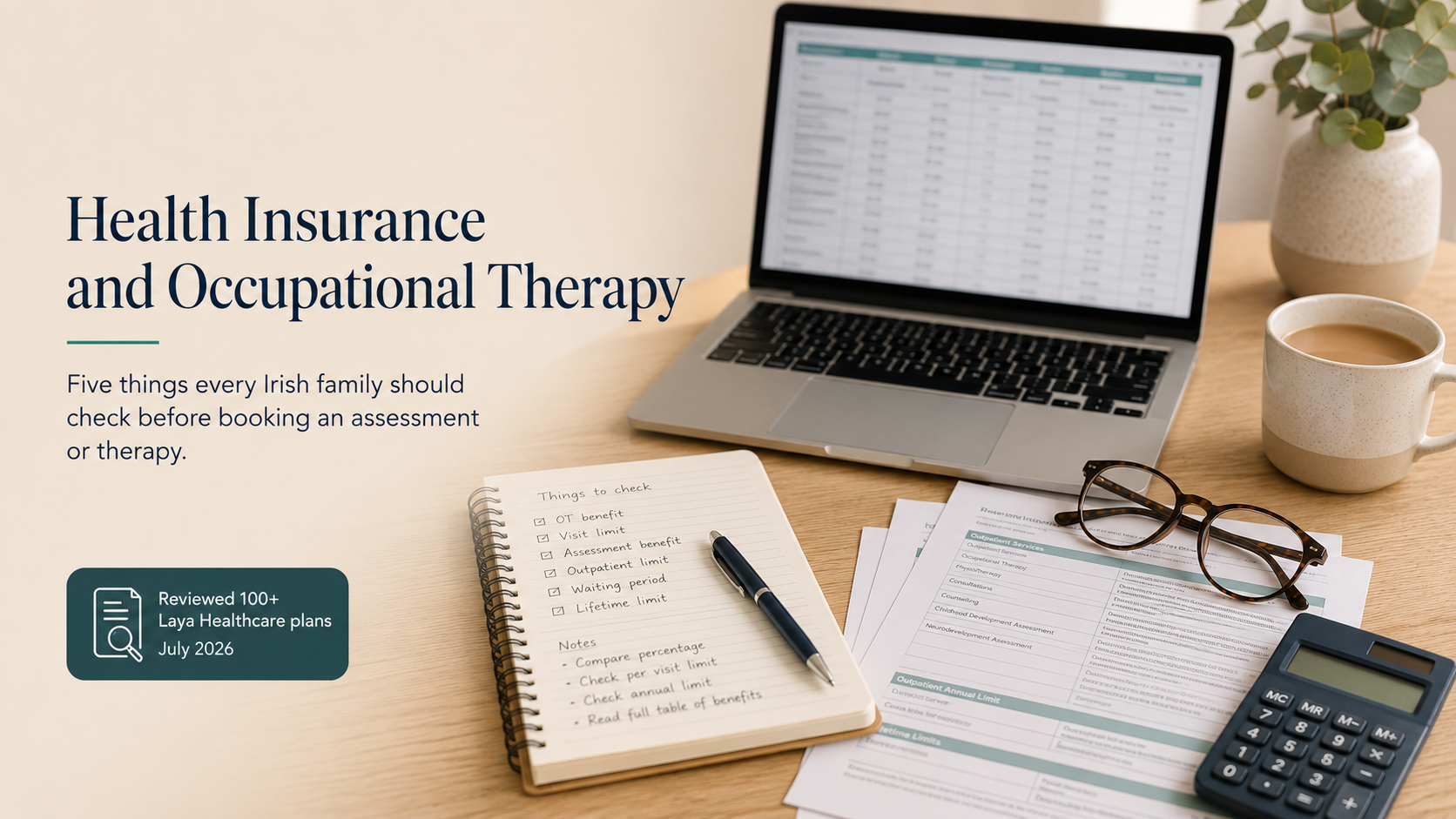
One of the most common questions families ask me, usually somewhere between “how long is the waitlist?” and “what will this cost?”, is whether their private health insurance will cover occupational therapy or a neurodevelopmental assessment.
The honest answer used to be, “It depends, and finding the information is not easy.”
I originally started this review because one family asked me to look more closely at their Laya Healthcare cover. They wanted to understand what occupational therapy and assessment benefits were available, and the information was not easy to find.
Once I started looking, I realised many other families were likely asking the same questions. So I kept going.
What began as answering one family’s question became a detailed review of more than 100 Laya Healthcare plans. I compared occupational therapy benefits, childhood development assessment benefits, adult neurodevelopmental assessment benefits, physiotherapy, play therapy, counselling, out-patient limits and price.
My aim was to help families understand their options and access support.
I also used AI to help organise and cross-check the information. But the detailed benefit tables on the insurer’s website sit behind expandable sections that automated tools cannot read. Every plan still had to be opened individually, every benefit table expanded, and the relevant information checked manually.
A quick note before we start: this review focused on Laya Healthcare because that was the provider I was asked to check. The specific figures below relate to Laya plans available in July 2026, but the five checks apply whichever Irish health insurer you use.
What I found surprised me. Some plans quietly offer excellent cover. Some expensive plans offer almost none. The difference between paying fully out of pocket for an assessment and getting hundreds of euro back can come down to a single line in a document most people never read.
Here are the five things I would want every family, and every adult exploring questions about ADHD, autism or Developmental Coordination Disorder (DCD), to know when reviewing their health insurance.
1. Price does not equal cover
This was the finding that genuinely surprised me. I found plans costing over €280 a month with no cover at all for occupational therapy or developmental assessment, and plans costing under €150 a month covering both, generously.
Why? Insurers often design newer plans to attract new customers, while older plans sit unchanged for years as their prices creep up. If you have held the same plan for a long time, there is a real chance you are paying more for less. Newer benefits, such as adult neurodevelopmental assessment benefits, may not exist on older plans because they were not part of the market when the plan was created.
What to do: at renewal, ask your insurer directly: “What are your newest plans, and do they cover occupational therapy and developmental assessment?” Do not assume your loyalty is being rewarded.
2. Find the occupational therapy line and read all of it
Almost every plan’s benefit table has a line for occupational therapy, but the differences hide in the detail. Across the plans I reviewed, OT cover ranged from:
- 75% of costs with no limit per visit
- 50% of costs, uncapped
- 50% up to €45 per visit
- €25 per visit, for a maximum of 3 visits a year
- No cover at all
Those last two look like cover. In practice, €25 towards three sessions a year barely touches a meaningful block of therapy. A plan paying 75% of a €120 session looks very different from one paying €25 towards the same appointment.
When you compare plans, the questions that matter are: what percentage is paid back, is there a cap per visit, and is there a limit on the number of visits each year?
3. There are two assessment benefits and one of them is easy to miss
If you are looking at an assessment for your child, perhaps because there are questions about autism, ADHD or Developmental Coordination Disorder (DCD), the benefit to look for is usually called childhood development assessment. On the plans I reviewed, it ranged from nothing at all up to 75% of costs to a lifetime limit of €1,000.
If you are an adult wondering about your own neurodivergence, there is a newer benefit called the Neurodevelopment Assessment Benefit for Adults. It is one of the most welcome changes in the Irish market, and one of the easiest benefits to miss. It only appears on some recently launched plans, and it does not always appear in the short summary document.
Where it exists, it typically covers 50% to 75% of assessment costs, up to a lifetime limit of €250 to €1,000.
One important word in both benefits is lifetime. These are not annual allowances. They are usually claimable once. That makes them genuinely valuable, but it also means the claim is worth planning carefully.
4. The out-patient limit can quietly cancel out a generous benefit
Check whether your plan has an annual out-patient limit. This is the ceiling on the total you can claim back across everyday medical expenses in a year, including GP visits, physiotherapy, occupational therapy, dental, counselling and more.
On good plans this limit is high enough that many families will never realistically reach it. But I found plans advertising a €750 assessment benefit alongside an annual out-patient limit of €1,000.
Do the maths. One assessment plus a handful of OT sessions and the ceiling is reached. Everything after that comes out of your own pocket, no matter what the individual benefit lines appear to promise.
What to do: when comparing plans, put the out-patient limit next to the individual benefits. A slightly smaller assessment benefit on a plan with a high annual limit may be worth far more in real life.
5. Do not rely only on the summary document
Every plan has a short summary called an Insurance Product Information Document, often called an IPID. It is useful for hospital cover and broad plan information. But in my review I found that the adult neurodevelopmental assessment benefit did not appear in these summaries at all, even on plans that did include it in the full benefit table. I also found summaries that omitted childhood development assessment benefits on plans that covered them.
The more reliable source is the full Table of Benefits on the plan’s own page, or the member booklet. It is longer and less friendly, but it is much closer to the document your claims are assessed against.
Search it for three phrases:
- occupational therapy
- childhood development assessment
- neurodevelopment
Those three searches can tell you more than the summary document alone.
What to consider when reviewing your health insurance
| Area to check | Question to ask |
|---|---|
| Occupational therapy benefit | What percentage is paid back, and is there a cap per visit? |
| Visit limit | How many occupational therapy visits are covered each year? |
| Assessment benefit | Does the plan cover childhood development assessment or adult neurodevelopmental assessment? |
| Out-patient limit | What is the total annual ceiling across everyday medical expenses? |
| Waiting period | If this is a new or upgraded benefit, when can you claim? |
| Lifetime limit | Is this a once-ever benefit rather than an annual allowance? |
A worked example: what switching can actually be worth
Suppose you are paying around €140 a month for an older plan with no assessment cover, and you are considering an adult neurodevelopmental assessment costing €1,400. Based on plans available in July 2026, switching to a current-generation plan costing €4 to €15 more per month might return €400 to €500 on that assessment, before counting new cover for children’s occupational therapy, assessments, play therapy or counselling that the older plan may never have included.
Check waiting periods alongside eligibility, benefits and the full cost. When you move to a plan with a benefit your old plan did not have, the insurer may apply a waiting period before you can claim it.
Ask the direct question: “If I switch today, when can I claim the neurodevelopment assessment benefit?”
Waiting periods often relate to moving to a higher level of cover or adding a benefit you did not previously have. If you have already served waiting periods for equivalent benefits, you may not need to serve them again. Always ask your insurer to explain exactly what applies to your circumstances before switching.
The bigger picture
None of this should be so hard to understand. Families navigating autism, ADHD or DCD pathways are already carrying enough without needing to become insurance analysts. Access to assessment and therapy should not hinge on decoding a benefits table.
But while the system is what it is, knowing these five checks can put real money back in families’ pockets. I would rather families spent that money on the things that help their child, young person or themselves take part in the everyday life they want.
Occupational therapy helps people participate more easily in everyday life. That might include play, learning, dressing, handwriting, organisation, sensory processing, executive functioning, work, study, self-care or independence. Assessment and therapy are significant investments for many families, so understanding your insurance cover is worthwhile.
At Belong OT, assessment is a clinical tool we reach for when it will genuinely answer a question. It is not the default starting point for everyone.
Five things to remember
- Expensive plans are not always the best value.
- Check the occupational therapy benefit, not only the monthly premium.
- Child and adult assessment benefits are different.
- Always check the annual out-patient limit.
- Read the full Table of Benefits, not only the summary document.
Want the spreadsheet?
Yes, the spreadsheet is real: every Laya plan that passed my screen, with occupational therapy cover, childhood development assessment benefit, adult neurodevelopmental assessment benefit, play therapy, physiotherapy, out-patient limit and price, all in one place.
If you would like a copy of my Laya comparison spreadsheet, or you are unsure whether occupational therapy is the right next step, get in touch. I would be happy to help you understand your options.
You may also find these pages helpful: Occupational Therapy Assessment, Children and Young People, Adults and Pricing.
Information note: This article is provided for general information only and is not financial or insurance advice. The information was checked against Laya Healthcare’s published benefit tables in July 2026. Insurance products, prices and benefits change over time, so always confirm your cover directly with your insurer before making decisions.
While this review focuses on Laya Healthcare because that was the provider I was asked to check, the same principles apply when reviewing plans from other Irish health insurers.