Belong OT blog
Why I love GAA All Stars as an OT, and how to find or start one near you
A reflection on participation, belonging and the quiet power of making community sport fit the child.
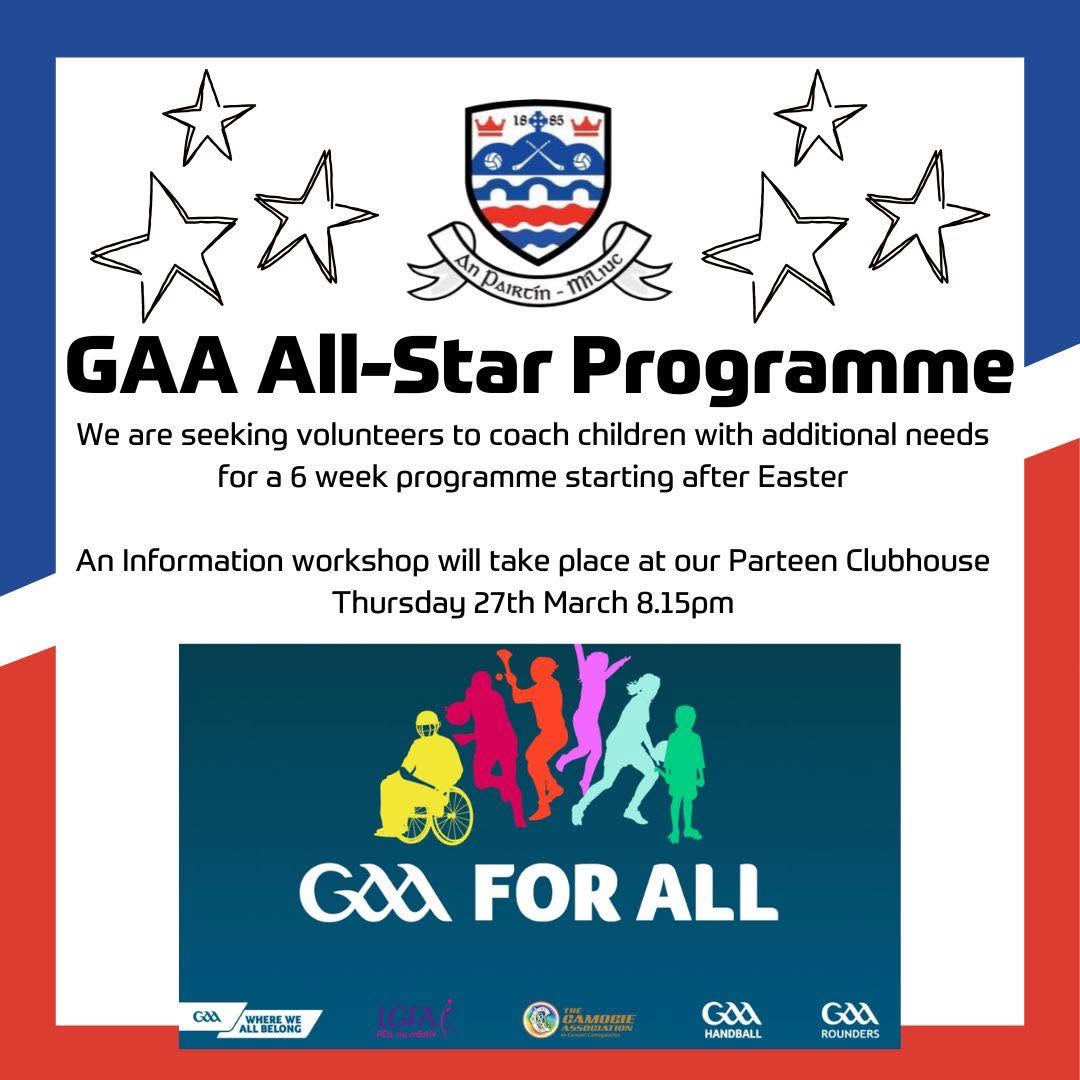
For current programme dates, availability and eligibility, contact the club directly.
This year I was honoured to be asked to present the medals on the final night of the Parteen/Meelick GAA All Stars, a six-week participation-focused programme for children on the Clare and Limerick border.
Every child received a medal. Not for scoring. Not for winning. For coming along, for trying, for having fun, and for belonging.
I was only there for that last evening, but it was enough. Talking with parents, hearing what the programme had meant to their families, and watching the children collect their medals showed me what had been built there week after week by the coaches and volunteers.
My own small contribution was creating a parent information leaflet and a child-friendly achievements workbook, and sharing some thoughts on how visual supports, predictable routines and simple participation tools could be woven into future sessions.
I have spent over 21 years working as an occupational therapist. What those parents described is exactly what meaningful participation looks like. It is also one of the most quietly powerful things happening in Irish community life right now.
What is GAA All Stars, and why does an OT care so much?
Open the topics most useful to you.
What GAA All Stars is
All Stars is part of the wider GAA For All approach. The Gaelic Games All Stars Programme is described by the GAA as a player-centred programme led by volunteers, focused on physical literacy and belonging in an inclusive, supportive environment.
At its heart, an All Stars programme is simple. Children with additional needs, or children of all abilities depending on the club, come together regularly for GAA activities in a safe, supportive and low-pressure environment.
What makes it different
There are no trials. No league tables. No bench. The goal is not perfect motor skills. The goal is meaningful, enjoyable participation.
Why this matters through an OT lens
As an OT, this is the language of my profession made real on a pitch. Occupational therapists think about the fit between the person, the activity and the environment.
A child might have every interest in hurling or football, but if the environment is loud, fast, competitive and unpredictable, the fit breaks down.
All Stars does not ask the child to change so they fit the sport. It changes the environment so the sport fits the child.
Why the GAA context matters
In Ireland, the GAA is more than sport. It is the jersey, the pitch, the Saturday morning routine, the parish, the cousins, the neighbours and the sidelines.
When a child is included in that, they are included in something bigger than a game.
What makes these programmes work
Having seen the final night of one programme up close, and having looked at what works around the country, the same design principles appear again and again.
Flexible participation
Child-led sessions
Some children run straight in. Some watch first. Some stay near family, take breaks, or repeat one favourite activity. All of these ways of joining in count.
Predictability
Clear routines
Same time, same place, same welcome. Many children participate more confidently when the session has a clear beginning, middle and end.
Support
Small ratios
Smaller groups and extra adult support help children feel safe, noticed and included. This means no child gets lost in the crowd.
Parents are supported too. These programmes often become a community for the adults as much as the children. A place where parents breathe, connect and watch their child be celebrated.
Belonging comes before performance. When children feel safe, accepted and successful, they play, explore, connect and try new things in their own time.
Where All Stars programmes are running
The good news is that this model is spreading. Open the sections below for examples.
Munster examples
Corofin All Stars in Co. Clare was developed with occupational therapy involvement. It is a strong local example of inclusive GAA practice shaped by everyday participation, visibility and belonging.
Caherline All Stars in Co. Limerick announced a six-week programme in 2026 for children with additional needs, focused on fun, movement and games in a safe and supportive environment.
Midleton Magpies in Cork have become a flagship example. In 2024, the GAA reported that Midleton Magpies All-Stars became the first team with additional needs to play a hurling match at Páirc Uí Chaoimh.
Dublin, Wicklow, Cavan and Ulster examples
Raheny All Stars in Dublin was established in September 2016 and is recognised as an early example of the All Stars model. The original aim was to include children who could not take part in a typical team game, with ball skills, exercise, fun and enjoyment in a safe environment.
Blessington All Stars in Wicklow run child-led sessions and have developed further inclusive supports, including sensory-focused spaces and activities.
Cavan GAA has also run a free All Star Programme for boys and girls aged 5 to 14 with a disability, with ten weekly one-hour sessions.
Ulster GAA describes its Games for All work as supporting over 40 units and more than 1,000 additional people to participate.
Parteen/Meelick
And of course, Parteen/Meelick, where I had the honour of presenting the medals this year.
How to find a programme near you
If you are a parent wondering whether something like this exists in your area, start close to home.
Step 1: Ask your local club
The Juvenile Secretary, Children’s Officer or Inclusion Officer is often the right first contact. Ask whether the club already has an All Stars programme, inclusive team, adapted session or volunteer who supports inclusion.
Step 2: Contact your Local Sports Partnership
Ask for the Sports Inclusion Disability Officer. In Clare, you can contact Clare Sports Partnership and ask for guidance on inclusive sport options.
Step 3: Use the GAA All Stars resource hub
The Tobar All Stars Programme page includes club, coach, disability and video resources.
Step 4: Ask other parents
Local parent networks often know which clubs, coaches and community groups are open to adapting sessions.
One practical note. Mixed teams of boys and girls are generally permitted up to and including Under 12 in many Gaelic Games contexts. For older children and teenagers, ask the club how they link with LGFA, Camogie or other suitable options.
How to start one at your club
If you are a coach or club volunteer thinking, “We could do that here,” you are right. You could.
Training and first conversations
In March 2026, the GAA, LGFA, Camogie Association, GAA Handball and GAA Rounders launched an official All Stars Coaching Workshop. The GAA information encourages clubs and volunteers who want to get involved, host a workshop or begin the coaching pathway to contact the relevant association lead.
Simple start-up steps
- Bring the idea to your club executive.
- Appoint a lead coordinator, often a parent or volunteer with strong local knowledge.
- Link with your Games Promotion Officer, Children’s Officer and relevant association supports.
- Complete required safeguarding, vetting and coaching supports.
- Start small, with a consistent weekly slot and a child-led approach.
- Ask families what helps their child feel safe, prepared and included.
Funding routes
Funding routes change over time, but Sport Ireland’s Sport for All Disability Supports Club Fund has previously supported grassroots clubs with funding between €1,000 and €5,000 for disability-specific activities, education, training, equipment and supports.
Clubs should check the current route through their national governing body, county board or Local Sports Partnership.
Where OTs fit in all of this
There is a natural fit between occupational therapy and inclusive community sport.
OTs understand participation. We look at what the child wants to do, what the activity asks of them, and what the environment expects. Then we help adjust the fit.
Before the session
Preparation supports
Social stories, simple maps, first-then boards, visual schedules and child-friendly explanations help children know what to expect.
During the session
Participation tools
Choice boards, task boards, break cards, sensory supports and graded activities help children join in without pressure.
Around the child
Shared understanding
A short information sheet for a coach or volunteer can explain what helps, what to avoid and how to support success respectfully.
How a small OT consultation might help
An OT consultation helps families explore suitable activities, practical supports and what to share with coaches.
This might include a social story, visual schedule, task board, coach information sheet, or a simple plan for what to try first.
Why simple supports matter
This does not need to be complicated. Often, the most useful supports are simple, clear and practical.
Why sensory access matters
Croke Park’s sensory room, Cú Chulainn’s Corner, is another sign that inclusion is moving from the margins of Gaelic Games towards the centre. This matters. Children notice when they are expected. Families notice when they are welcomed.
Example resources coming soon
I am planning to add a small set of editable example resources for clubs and families who want to support inclusive participation in community sport.
What the resources will be
These will be Belong OT example resources, not official GAA resources. They will be designed so clubs can adapt them to their own setting and families can use them as a starting point for conversations with coaches or volunteers.
Planned examples
- Parent information leaflet example
- Child achievements workbook example
- Visual schedule example
- Coach or volunteer information sheet example
What families and clubs can do now
For now, families and clubs are welcome to contact Belong OT if they would like help thinking through practical supports for one child, one activity or one community setting.
Questions parents and clubs might ask
Does my child need a diagnosis to take part?
Not always. Each club or programme sets its own criteria. Many inclusive programmes focus on what helps the child participate, rather than diagnosis alone. Ask the club how they decide suitability and what information they need from families.
What if my child watches more than they play?
Watching is still participation. Some children need time to observe, learn the routine, feel safe and build trust. A child-led programme values different ways of joining in.
What supports might help my child join in?
Useful supports might include a visual schedule, social story, first-then board, movement break option, familiar adult, quiet space, predictable start and finish routine, or one clear job at a time.
How could Belong OT help with community participation?
Belong OT can support families to think through what might help a child access a community activity. This may include practical resources such as a social story, visual schedule, task board, coach information sheet or parent planning support.
I am a club volunteer. Where should we start?
Start with your club executive, Children’s Officer, Games Promotion Officer and county or association supports. Keep the first step small, safe and consistent. Ask families what helps. Build from there.
Back to the pitch
On the last night at Parteen/Meelick, the medals said it all.
I came. I tried. I had fun. I belonged.
No child should have to earn their place in their community through performance. Every child already belongs. Programmes like GAA All Stars simply make that belonging visible, week after week, on the same pitches where their parents and grandparents played.
Start by asking your local club about inclusive options and practical supports. If you need help thinking this through, an occupational therapy consultation can support you to identify practical next steps and create simple resources that help your child participate with more confidence.
Want to support your child to join in community life?
Belong OT can help families think through community participation, prepare practical visual supports, and share useful information with coaches, clubs or volunteers.